
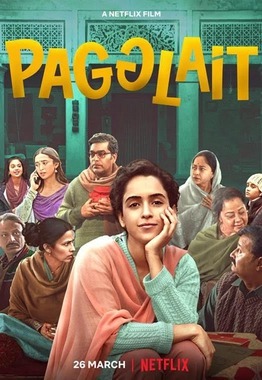
PAGGLAIT
Cast: Sanya Malhotra (Sandhya Giri nee Pandey), Astik (Sandhya’s husband, not shown), Ashutosh Rana (Shivendra Giri, Astik’s father), Sheeba Chaddha (Usha Giri, Astik’s mother), Chetan Sharma (Alok Giri, Astik’s younger brother), Sayani Gupta (Akansha Roy), Shruti Sharma (Nazia Zaidi), Aasif Khan (Parchun), Natasha Rastogi (Alka Pandey, Sandhya’s mother), Bhupesh Pandya (Girish Pandey, Sandhya’s father), Raghubir Yadav (Pappu Giri or Tayaji), Yamini Singh (Janaki Giri, Shivendra’s sister), Jameel Khan (Janaki’s husband and a banker), Rajesh Tailang (Tarun Giri, Shivendra’s younger brother), Ananya Khare (Rashmi Giri, Tarun’s wife), Meghna Malik (Tulika, Shivendra’s sister-in-law), Nakul Roshan Sahdev (Aditya Giri, Tarun’s son), Ashlesha Thakur (Aditi Giri, Tarun’s daughter), Sachin Chaudhary (Tulika’s son), Saroj Singh (Dadi, Astik’s grandmother)
Director: Umesh Bist
Screenwriter: Umesh Bist
Producer:Shobha Kapoor, Ekta Kapoor, Guneet Monga, Achin Jain
Platform: Netflix
Production: Balaji Motion Pictures, Sikhya Entertainment
Release Date: 26th March 2021
Rating: 4/5
When a Woman Becomes Wise…
Pagglait is about a newly married widow, Sandhya, who comes to terms with the unexpected death of her husband. As she craves for pepsi and chips in the isolation of her room, Sandhya cannot yet fathom the reason for her listless indifference to the situation, while outside her in-laws shed tears preparing for their son’s 13 day Shraadh ceremony ( a sendoff for the peaceful departure of the deceased soul in hindu customs). As Tayaji (uncle) explains, during this period, the soul sheds all its earthly bindings and takes on a new body to undertake the journey to the underworld.
Sandhya, who had mistaken her husband’s disinterest in her as his lack of understanding about love, has her world suddenly blown apart with the accidental discovery of his girlfriend’s picture amongst his files which she pokes around unfamiliarly. Bemoaning her lack of emotions so far, this, instead unleashes a storm of anger, jealousy and betrayal. When Astik’s (her deceased husband) colleagues from work come home to pay their respects and offer condolences, she ends up unexpectedly encountering the woman from the picture, Akansha. She confronts her and strangely, expresses a desire to know aspects of her husband, as she heartbreakingly claims “Uski taste alag thi.”
What reigns supreme amongst Sandhya’s burst of emotions is a restlessness to know the man she is supposed to mourn but is unable to. She looks at Akansha with barely concealed excitement and plies her with endless questions: details on Astik’s real personality, likes and dislikes, their interactions etc. Sandhya, can’t help but notice that Akansha is the complete antithesis of who she is. Polished to her homely and dowdy appearance, dusky to her milk white and independent to her being restricted to the house. She studies her long french manicured nails with avid fascination as she hides her own. The two build up an unlikely camaraderie as she presses her for uncomfortable details about Astik. Sandhya decides to forgive Astik on the 10th day amidst tears over an unsavoury discovery followed by bouts of hunger as she finally finds her closure.
The extended family of the Giri’s gather at the family home to offer support and attend the 13 day funeral rites. Pagglait serves as an ideal setting to bring to light certain customs and traditions. But, they become lacklustre as the family gets more focused on snubbing each other, making snarky comments on their troubles rather than just coming together. Adding to this, is a brother who is coerced to follow practices like sleeping on the floor and eating bland food (a brother who has always been at odds with the seemingly responsible and meritorious Astik) and a widow who has no relations or emotional bonding, the practices seem more like an imposition thrust upon.
While Sandhya spends her days with Akansha, the family has another bombshell dropped on their heads: the existence of an insurance taken by Astik with his wife as the sole beneficiary. Sandhya, who was viewed as a burden left by her husband, suddenly finds herself coveted by all her relatives.
The history and dynamics of the family are explored through interactions of the secondary characters. There’s Parchun, who even makes excuses for smoke coming out of Sandhya’s room during a Nazarutharna ritual gone wrong and also indulges her sudden cravings for pepsi and Chips in spite of the vidhi’s to be followed in the house. The elders who manage saccharine smiles on their faces while giggling at each other’s misfortunes. Pagglait shows us not only the rigid and orthodox thinking associated with religious customs but also human hypocrisy. There’s Tayaji, who ensures that Alok adheres to every rule while he himself indulges in alcohol on the side. The family wastes no time in talking and fixing Sandhya’s alliance even though they are allegedly in mourning and it’s hardly the time to be preparing for a marriage. Sandhya’s own mother, who vacillates between keeping her daughter and passing her off as the responsibility of her in-laws based on her usefulness.
We have a subtle flirtation between the bindaas Parchun and Sandhya’s muslim friend Nazia Zaidi, who’s entrance into the house raises some eyebrows and under the breadth comments, with another set of rules to cater to dealing with her presence. And surprisingly, even our widow Sandhya manages to land some proposals. Though her relationship with her late husband was nothing to boast about, Sandhya does manage to carve a space in the heart of her brother-in-law, Alok, who she had spent coaching with English lessons and dadi (grandmother). If Aditya, another relative suddenly shows an interest in her, we are sure it’s got nothing to do with the insurance claim…
The 13 days of Shraad, was not only pass over for Astik; it serves as a transformation for Sandhya as well. Slowly, as each day passes, she learns a little more, heals a little more, emulates Akansha a little more and slowly a butterfly breaks out of a coccoon.
Sandhya who was coerced into marriage for a secure life,’ the boy earns well at 70k’ but not necessarily a progressive life. She topped her master’s course, but, there is never a question of her capability or her ability… only discussions on her emotional stability and on passing on her responsibility.
Conclusion
Pagglait comes across as a different movie, choosing unique topics and unique scenarios to present and address those issues in a passive manner through a passive character. We don’t have emotional dialogue deliveries, rescue sequences or dramatic confrontations.
Pagglait’s music is soulful, my favourite being Dil Udd Jaa Re, followed by the Phire Faqeera reflecting all the noise and latent torment Sandhya feels internally as she finally vents, or even Pagglait… the final song as Sandhya breaks free taking on a new lease of life.
Sandhya sends herself off like the gentle push of a boat on a river and with aplomb: not holding any grudges at being slighted, betrayed or even underestimated; instead, thanking everyone for what they did and did not do… with the heart to take up responsibility as the daughter of the family proving she is no lesser than the son.


